
Business
SWOT Analysis Mind Map Template
By RP Hobbyist · Updated
A SWOT analysis sorts everything you know about a business, product, project or career decision into four groups: Strengths and Weaknesses (internal factors you control) and Opportunities and Threats (external factors you don't). Laying them out side by side shows where you have an edge, where you are exposed, and which moves are worth making.
This template gives you the four SWOT branches around a central topic, ready to fill in. Because it is a mind map rather than a fixed 2×2 grid, each quadrant can grow as deep as you need: add evidence under a point, connect related ideas, and color-code the items you plan to act on.
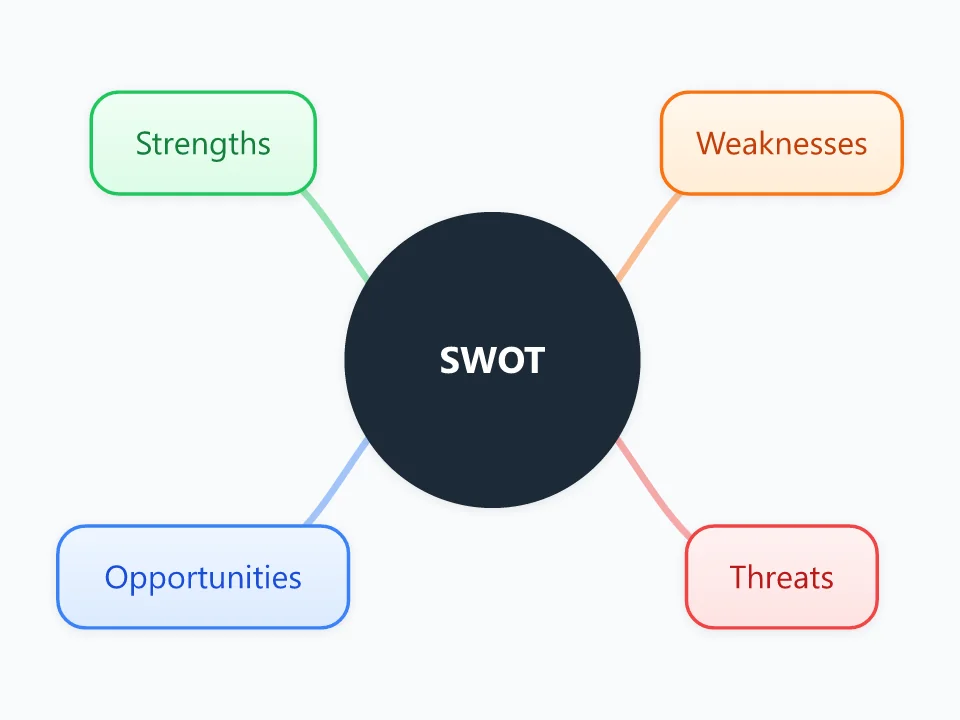
It opens as a new map with 5 topics already filled in. You don't need an account.
Open in the editorWhen to use a SWOT Analysis
- Before a strategy or annual planning session
- Evaluating a new product, market or business idea
- Comparing your position with a competitor
- A personal SWOT for a career move or interview preparation
What goes in each branch
- Strengths
- Internal advantages: what you do better than others, unique resources, skills, brand or cost position. Ask what customers praise you for.
- Weaknesses
- Internal limitations: gaps in skills, funding, process or product. Be honest; this is the branch teams most often leave thin.
- Opportunities
- External trends you could use: market growth, new technology, regulation changes, gaps competitors leave, possible partnerships.
- Threats
- External risks: new competitors, price pressure, supply problems, changing customer habits, legal changes.
Example: A small 3D-printing shop deciding whether to launch an online store
- Strengths: fast turnaround, in-house design skills, loyal local customers
- Weaknesses: no e-commerce experience; one person handles every order
- Opportunities: growing demand for custom parts; marketplaces with built-in traffic
- Threats: cheap overseas print services; rising filament costs
Tips
- Keep internal (S, W) and external (O, T) factors apart: a market trend is an opportunity or threat, not a strength.
- Write specific, evidence-backed points ("40% of customers reorder") instead of vague ones ("good service").
- Finish by pairing items: a strength that exploits an opportunity, or a strength that blunts a threat, becomes a concrete action.
- Limit each branch to the 3–5 most important points so the exported map stays readable.
Using this template in Neuron Mapping
- Click Open in the editor. The template opens as a new map.
- Select a topic and press Tab to add a branch under it, or double-click a topic to change its text.
- Select a topic to change its color and shape, or add notes to it in Markdown.
- When you're done, export the map as a PDF or PNG, or save it to keep editing later.
Everything runs locally in your browser: your map is saved on your device, works offline, and can be exported as PDF, PNG or an editable .nmm file.