
Business
Market Research Mind Map Template
By RP Hobbyist · Updated
Market research answers a business question with evidence: do people want this, who would pay for it, and what are they using now? Doing the research is often easier than keeping track of why you started, how you collected the data, and what it actually told you.
This template splits a study into four branches. Purpose (Needs, Risks, Opportunities) holds the questions you want answered. Procedure (Survey, Data, Report) is how you'll answer them. Results (Comparing, Features, Profit) records what you found, and Analysis (Pricing, Demand, Competition) is what it means for the business.
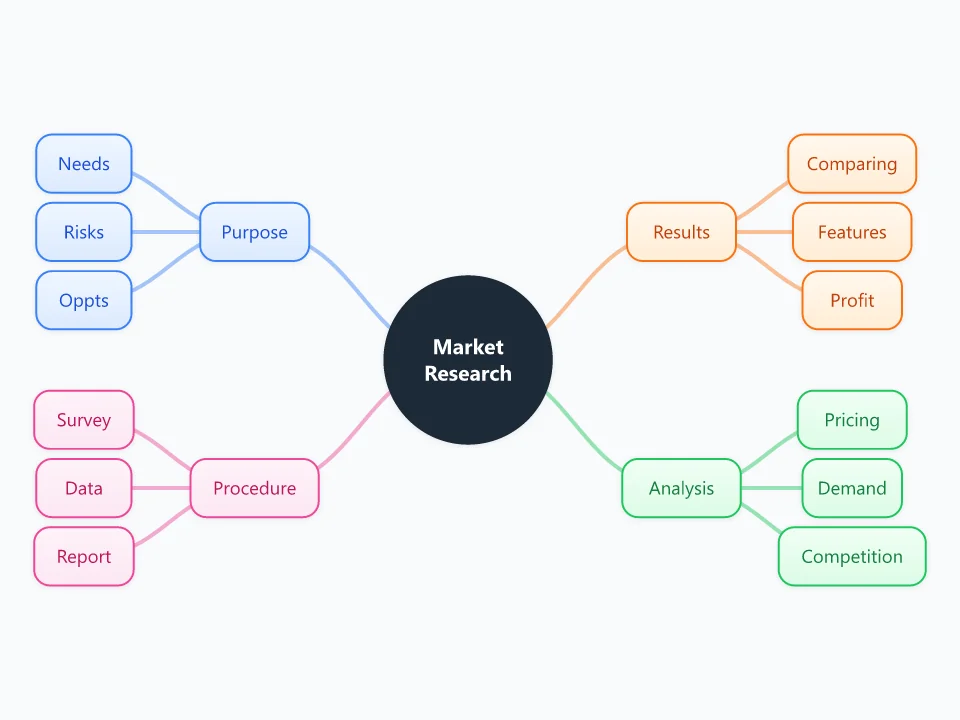
It opens as a new map with 17 topics already filled in. You don't need an account.
Open in the editorWhen to use a Market Research
- Before launching a product, to check that people want it
- Planning a customer survey or a round of interviews
- Looking at competitors before setting a price
- Pulling research from several sources together for a report or pitch
What goes in each branch
- Purpose
- Write down the decision the research should support, then list the customer needs, risks and opportunities you want to test. If a question doesn't connect to a decision, drop it.
- Procedure
- Survey covers your questions and who you'll ask. Data lists other sources, such as sales figures, industry reports or search trends. Report notes who gets the findings and in what form.
- Results
- Record findings as facts, with numbers where you have them. Comparing is for how you stack up against alternatives, Features for what people asked for, and Profit for what they said they would pay.
- Analysis
- Turn the results into conclusions about Pricing, Demand and Competition. Keep each conclusion short and point back to the result that supports it.
Example: A coffee roaster thinking about a subscription service
- Purpose: decide whether to launch monthly subscriptions this year. The main risk is that customers already buy coffee at the supermarket.
- Procedure: an email survey to 2,000 existing customers, plus a look at three competitors' subscription pages.
- Results: 31% of people who answered would subscribe, most wanted to be able to skip months, and the typical price they named was $14.
- Analysis: demand looks real among existing customers. Price it at $13 to $15 with free skipping, since two of the three competitors charge for skipping.
Tips
- Write the Purpose branch first and keep it short. Research without a clear question produces a lot of data and no answer.
- Put raw notes in node notes rather than in new nodes, so the map stays easy to read.
- Keep what people said apart from what they did. Purchase data beats stated intentions.
- Date your results. Market research goes stale, and a date shows when it's time to run it again.
Using this template in Neuron Mapping
- Click Open in the editor. The template opens as a new map.
- Select a topic and press Tab to add a branch under it, or double-click a topic to change its text.
- Select a topic to change its color and shape, or add notes to it in Markdown.
- When you're done, export the map as a PDF or PNG, or save it to keep editing later.
Everything runs locally in your browser: your map is saved on your device, works offline, and can be exported as PDF, PNG or an editable .nmm file.