
Business
Porter's Five Forces Mind Map Template
By RP Hobbyist · Updated
Porter's Five Forces is a framework for analyzing the competitive structure of an industry, introduced by Harvard professor Michael E. Porter in 1979. It looks at five forces that shape how profitable a market can be: competitive rivalry, the threat of new entrants, the threat of substitutes, the bargaining power of buyers, and the bargaining power of suppliers.
This template puts competitive rivalry at the center with the other four forces around it, each with a starting factor to assess: barriers to entry, switching costs, buyer volume and supplier uniqueness. Add evidence under each force and rate it high, medium or low to see where the pressure on your business comes from.
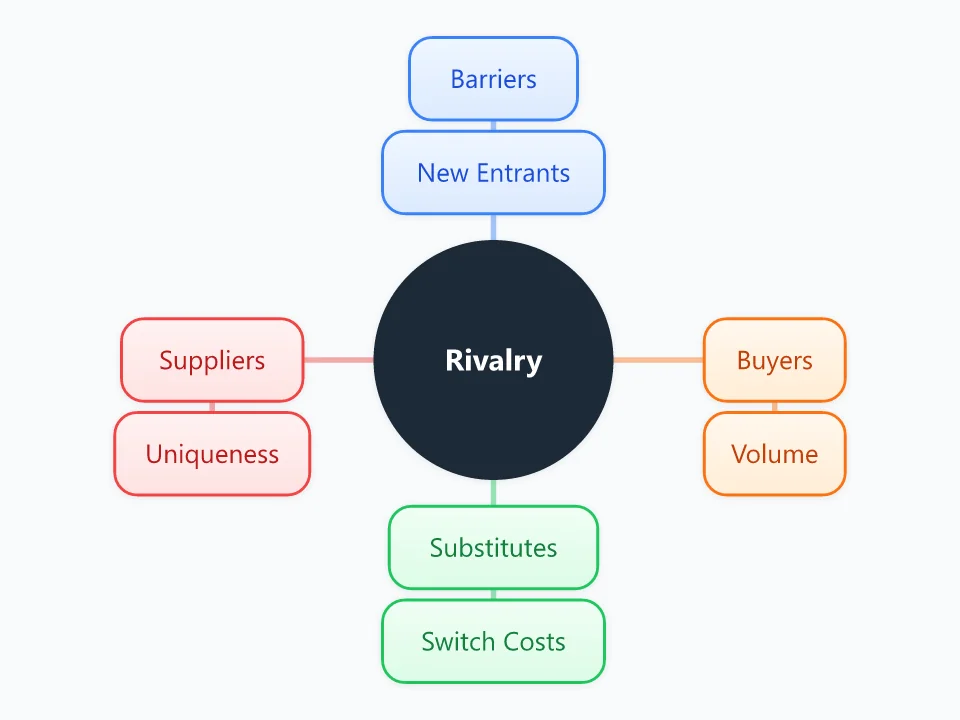
It opens as a new map with 9 topics already filled in. You don't need an account.
Open in the editorWhen to use a Porter's Five Forces
- Assessing whether a market is attractive before entering it
- Strategy work and business school case analysis
- Explaining why margins in an industry are high or low
- Adding an industry-level view to a SWOT analysis
What goes in each branch
- Rivalry
- Competition between existing players: number of competitors, industry growth, differentiation, price wars.
- New Entrants
- How easily new competitors can enter. Barriers include capital needs, regulation, brand loyalty and economies of scale.
- Substitutes
- Different products that meet the same need, and how cheap it is for customers to switch to them.
- Buyers
- Customer bargaining power: purchase volume, price sensitivity, concentration, ability to switch.
- Suppliers
- Supplier bargaining power: how unique their inputs are, how many alternatives exist, switching costs.
Example: The consumer 3D-printer filament market
- Rivalry: high, with many brands competing on price
- New Entrants: medium; little capital is needed, but brand trust matters
- Substitutes: low; there are few alternatives for FDM printing
- Buyers: high; prices are easy to compare online
- Suppliers: medium; there are a limited number of polymer producers
Tips
- Analyze the industry, not your company; the forces apply to every player in the market.
- Rate each force high, medium or low and color it to match, so you see the overall picture at a glance.
- Support each rating with evidence such as market data, pricing or the number of suppliers.
- Revisit the analysis when technology or regulation changes; the forces shift over time.
Using this template in Neuron Mapping
- Click Open in the editor. The template opens as a new map.
- Select a topic and press Tab to add a branch under it, or double-click a topic to change its text.
- Select a topic to change its color and shape, or add notes to it in Markdown.
- When you're done, export the map as a PDF or PNG, or save it to keep editing later.
Everything runs locally in your browser: your map is saved on your device, works offline, and can be exported as PDF, PNG or an editable .nmm file.